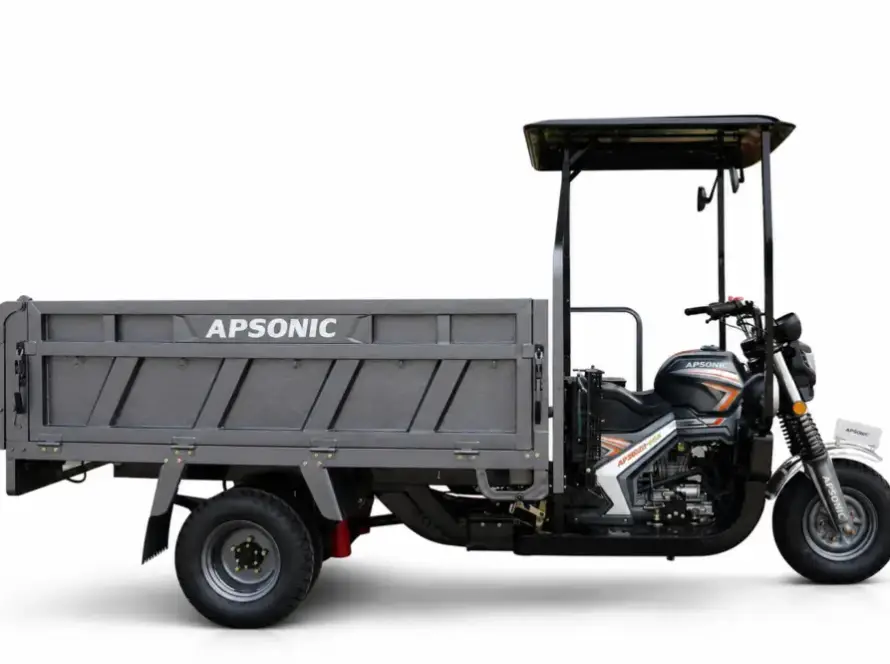
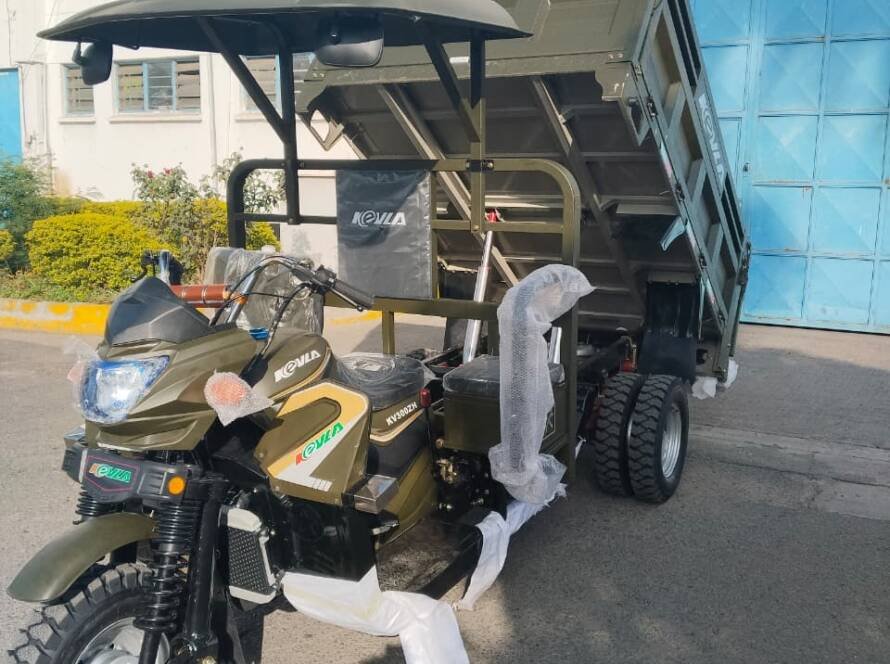
“How much does a cargo tuk tuk cost in Kenya?” is a harder question to answer honestly than most adverts make it look. Prices you’ll see quoted range anywhere from under KSh 300,000 for a stripped-down used unit to over KSh 750,000 for a heavy-duty new one, and the gap between those figures is almost entirely about engine size, cargo configuration and what’s actually included in the price. Here’s what a real 2026 cargo tuk tuk budget looks like in Kenya, cash and financed.
Cargo tuk tuk price range in Kenya (2026)
Across Ndisi Traders’ current catalogue of new cargo tuk tuks, prices break down roughly like this:
- Entry-level, 200cc: from KSh 350,000 — the Sonlink 200cc Agile, the most affordable model in the range, suited to light parcel and courier work.
- Mid-range, 200–250cc: KSh 355,000 – 520,000, including water-cooled options with better durability under sustained load.
- Heavy-duty, 300cc: KSh 520,000 – 750,000, including tipper and box-body configurations such as the Haojin MC300ZH-1G, built for the highest payload work.
These are new-unit prices for cargo-specific models. Passenger tuk tuks and used units are priced differently, and used-market listings vary widely depending on condition and mileage.
What actually changes the price
- Engine size and cooling. 200cc air-cooled engines cost less than 250cc or 300cc, and water-cooled variants cost more than air-cooled ones at the same displacement.
- Cargo configuration. An open flatbed is cheaper than an enclosed box body, which is cheaper than a hydraulic tipper.
- Brand and assembly. Established brands with a longer track record in Kenya tend to price higher than newer entrants, though the gap has narrowed as more brands compete on cargo models specifically.
- New vs used. A used unit costs less upfront but comes with unknown service history and a shorter remaining lifespan.
- Cash vs financed. Financed units cost more in total because of interest, but they free up capital you’d otherwise need to raise in one lump sum.
Cash purchase vs hire purchase — the real numbers
A cash purchase is the cheaper route overall: you pay the sticker price and own the unit outright, starting from KSh 350,000 for the most affordable model in the range.
Hire purchase spreads that cost, starting from around KSh 15,000 a month depending on the model, deposit and term you choose. Behind that monthly figure sits a fairly standard structure that most dealers don’t spell out until you ask:
- Flat interest of 3.5% per month on the financed balance
- A witnessing/CRB fee of KSh 400
- Comprehensive insurance, charged at 5% of the unit price or KSh 15,000, whichever is higher
- A GPS tracking fee of KSh 10,000
- A transfer fee of KSh 2,000
- An NTSA registration fee of KSh 1,000
- A disbursement fee of KSh 700
These fees are added once, at the start of the loan, on top of whatever deposit and financed balance you agree on. Any dealer offering hire purchase should be able to show you this breakdown, not just a headline monthly figure.
Costs beyond the sticker price
Once you own the unit, budget for annual insurance renewal (roughly 1% of the unit’s value, prorated to your cover period), NTSA and county licensing, fuel, routine servicing and spare parts, and a driver’s wage if you’re not operating it yourself. None of these are large individually, but together they’re what determines whether the business actually turns a profit.
How to calculate your exact monthly payment
Rather than working through the fee schedule by hand, Ndisi Traders’ financing calculator does it for you — pick a model (or enter your own price), set a deposit and a term, and it shows the exact deposit, monthly payment and total cost before you commit to anything.